

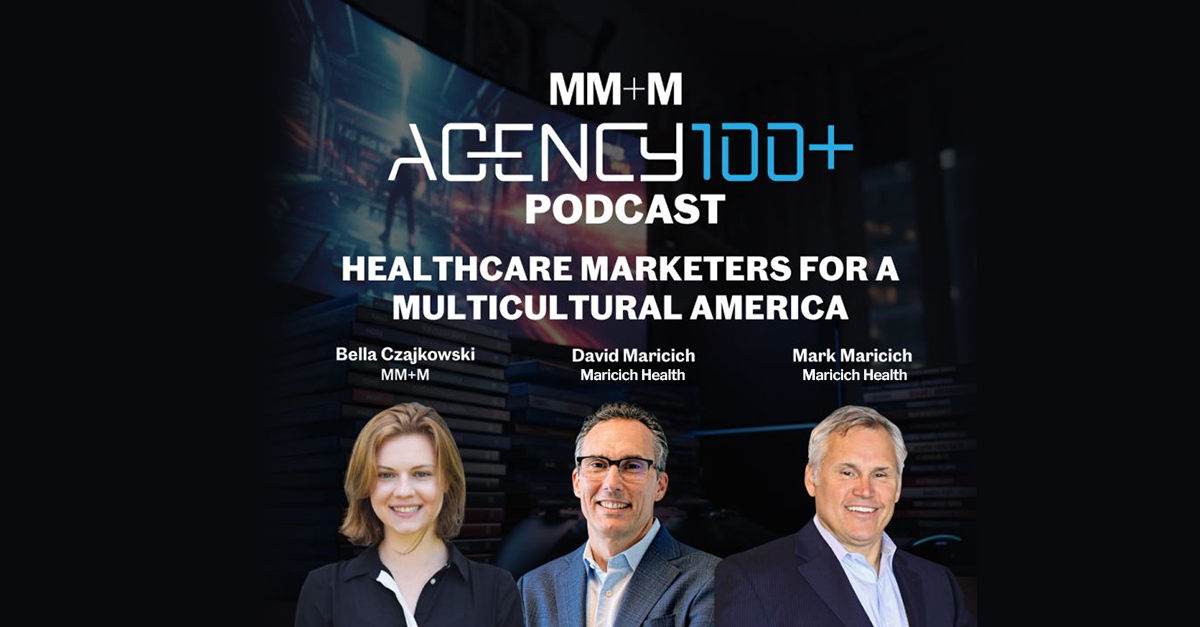
Mark Maricich, CEO and Chief Strategist, and David Maricich, President and Chief Creative Officer of Maricich Health, were recently featured on the MM+M Agency 100 podcast. MM+M (or Medical Marketing and Media) recognizes standout agencies making an impact across the healthcare marketing landscape through its Agency 100 list, which featured Maricich Health in the ‘Ones to Watch’ category.
Hosted by Bella Czajkowski, the episode explores the evolution of healthcare and pharma marketing, the growing importance of multicultural audience engagement and what it takes to build an agency legacy over four decades.
In the conversation, Mark and David share the vision and values driving Maricich Health forward, from the agency’s roots as a multigenerational family business to its evolution into a full-service healthcare marketing and branding firm. They also discuss the agency’s work across the integrated healthcare ecosystem and what it means to be recognized among the industry’s top agencies.
A special thanks to MM+M for spotlighting Maricich Health and its leadership in healthcare marketing.
Listen to the podcast:
Transcript:
[Preview Intro]
DAVID MARICICH: This is just a fascinating time. The things that we’re able to do with the technology at our fingertips is amazing, and every day we are looking at ways to integrate that for the benefit of our clients.
MARK MARICICH: Many of our campaigns that we’re launching in different languages, we engage in research, focus groups, and testing. This is the real deal — real insight, real impact, real results, real connection with audiences of different cultures.
[Interview Start]
BELLA CZAIJKOWSKI: Hello, and welcome to the MM+M Agency 100 podcast, brought to you by Marissa Health. I’m Bella Cazijkowski, a reporter here at MM+M. Today we’re talking about the evolution of healthcare and pharma marketing and the growing importance of multicultural engagement. With the agency celebrating 40 years in business, I’m pleased to be joined by Mark Maricich, CEO, and David Maricich, President and Chief Creative Officer. How’s it going today, guys?
MARK & DAVID: Great! Hi, Bella.
BELLA: Let me ask the question that’s on everyone’s mind. You share a last name and a business name, so the assumption is that you’re related. Tell us about that relationship, how you work together, and how that dynamic has shaped the agency over the years.
DAVID: Thanks, Bella. We’re celebrating 40 years of Maricich Health, and it really goes back to a family enterprise that Mark and I weren’t originally involved in. Early on, we both went into entertainment in LA and worked with various clients but eventually found our calling back at the agency and in healthcare. It’s now been 25-plus years working on a variety of healthcare and life sciences clients across the country and internationally.
The agency was started by our mother, Suzanne. She was one of the first women in hospital boardrooms and launched what is considered the first-ever advertising campaign for a hospital on the West Coast — for St. Mary Medical Center in Long Beach, California. From there she worked at other hospitals, then started the agency in 1986.
Meanwhile, Mark and I were off doing other things. Mark worked in TV and film — he was actually an extra on, I think it was Matlock, or maybe Walker, Texas Ranger. And I was in the music business, working as a talent scout with bands like Tool and Matthew Sweet. In the late ’90s and early 2000s, we connected the dots, started working together, and transformed what was essentially a healthcare publishing company into an integrated branding and marketing agency focused solely on healthcare.
The beauty of a family-run agency is that you can be really honest with one another — not just about the business, but about the client work. Mark and I have had some very spirited conversations over the years, but they’ve always led to better output and better outcomes for our clients. It’s been a fun, interesting family journey. Mark and I took over running the agency about 12 years ago when our mom retired. She unfortunately passed away a couple of years ago, but she was always involved and loved coming in for events. Mark, anything to add?
MARK: Sure. I did a couple of extra spots but mostly worked in TV and film — I got my degree in it. I started doing industrial films, eventually got into feature films, worked as a grip, and also led production at a television station in Vail, Colorado, producing local spots. The grip side of my career eventually wound down — I got stuck on a circuit of bad werewolf movies and worked on a film in the desert called Motorcycle for about a month, basically just watching a guy ride around on a motorcycle. So I transitioned into the agency business, working a lot in healthcare but also in B2B and consumer brands. That hands-on agency experience, combined with my film production background, really shaped my approach.
DAVID: There’s another interesting thread in our family story — a fishing heritage. Our great-grandfather and those before him were Croatian fishermen. Our grandfather immigrated to the U.S. in the early 1900s and settled in the Pacific Northwest, working on fishing boats in Puget Sound and Alaska. There was a family tradition of sending the boys up to Alaska at 14 or 15 to learn a work ethic. Mark went first at 15; I followed six years later. We both fished in Kodiak, Alaska — Mark also did a stint in Southeast Alaska fishing for salmon, halibut, and other species. We were essentially on the same grounds as the Deadliest Catch fishermen, dealing with stormy weather and very long days of hard work.
That experience translated directly into our culture at the agency. We roll up our sleeves and get embedded with our team on every project. In this business, you sometimes have to put the time in and get it done for your clients — and that’s second nature to us because of how we grew up.
MARK: There’s a nice analogy there. When we were commercial fishermen in Alaska, we were casting our nets to feed the world. Now, running the agency, we’re still casting nets — but to people, helping them gain access to healthcare. We’ve always had a purpose. Back then it was feeding the world; now it’s helping people access care and the greatest treatments available. It’s always been a purpose-driven approach to life, and it’s really about connecting with people on a larger scale.
BELLA: Maybe you guys, better than anyone in the agency landscape, can speak to long-term trends in this industry. Looking back over 40 years, what are some of the biggest changes in healthcare, pharma, marketing, and communications that have shaped your work?
MARK: We always say the greatest constant in healthcare marketing is change. But looking back four decades, one of the biggest shifts was simply that people started marketing at all. There were no ads for hospitals, doctors, or pharma — none. As Dave mentioned, our mother Suzanne was a true trailblazer, launching what many consider one of the very first hospital ads ever. We actually have some of those original ads here in the office.
Then in the late ’90s, the FDA allowed adequate provisions in pharma advertising rather than requiring the full prescribing information — that was really the beginning of pharma advertising as we know it today. In the mid-2000s, Kaiser Permanente’s “Thrive” campaign marked the first major provider branding campaign. I remember being in a meeting with a health system administrator who said, “Did you see that ad? I want to be like that.” That started a genuine shift toward health systems investing in brand-building.
Then in the early 2010s, the Affordable Care Act opened up access to care on an unprecedented scale and expanded Medicaid significantly. Of course, the political climate around all of this keeps shifting, so we’re always adapting. And then there’s the explosion of digital media, social media, AI tools — the ability to reach people where they live, work, and play, with a richness of data we never had before.
One of the most meaningful changes has been the growing recognition by clients of the importance of truly connecting with multicultural audiences — communicating with them in ways that authentically resonate with their communities. That’s been a huge part of our differentiation.
DAVID: And now here we are in the age of AI. Every day it’s on the agenda of every meeting — it’s what we’re thinking about, experimenting with, and actually executing for clients. I have a saying around here: “My life is not boring.” The team even made me a T-shirt. It can feel daunting, but the things we’re able to do with the technology at our fingertips are genuinely amazing.
Let me give you an example. We had a client we thought would be fairly conservative about AI — and it turned out they were already experimenting on their own. Once we learned that, we dove in together. With tighter budgets, we were able to supplement video in a creative way that actually helped us tell a better story. That’s our key criterion: we won’t use AI unless it genuinely enhances the storytelling. It shouldn’t be distracting — you shouldn’t watch it and think, “Oh, that’s fake AI.” It should be seamless.
We were doing a hybrid approach, integrating actual footage and using that to train AI for other scenes. Our litmus test was showing the final product to our full production team and asking them to point out the AI. Nobody could — in fact, they guessed wrong, identifying the real footage as AI and the AI content as real. That’s the level of integration we’re going for.
We also have a campaign running right now with AI-assisted creative — hybrid production — and we’re seeing higher engagement. A better story, better results. We have a strong team including business affairs and legal reviewing everything, we’re working closely with clients, and we’re staying on top of the legal landscape, which is changing daily. I tell people: take “AI” and swap in “the internet,” then imagine it’s 1996. If someone said “I’m afraid of using the internet,” you’d look back on that and think it sounded silly.
DAVID: You have to ride the wave — I’m a surfer, I love surfing here in California. You’ve got to ride the wave of AI, or you’re going to get buried by the whitewash. That’s our philosophy.
BELLA: Yeah, I think that’s a great way to put it. And I like what you said about a litmus test. Even in just the past year, image generation has come so far — early on everything looked dreamy and cartoony, and now it can be nearly indistinguishable from real footage.
DAVID: There are real dangers, especially with testimonials. You see some shady actors using AI-generated people in pre-roll ads on YouTube, and it’s clear they’re not real — often from foreign companies trying to deceive consumers. We obviously don’t support anything like that. But in legitimate storytelling, there’s always been a degree of craft involved: hiring actors who aren’t real patients, using stock footage shot in another country, Photoshop retouching, CGI. AI is the next evolution of that, and if used properly it’s powerful. But you have to be very careful it doesn’t misrepresent the brand. And with disclosure laws now emerging — like what New York has recently passed — we’re watching closely to see how that spreads nationally or internationally. It’s a constant state of change, but it keeps life very interesting.
BELLA: All right, Mark, you mentioned multicultural expertise as a real differentiator. Can you talk about how you came to focus on that, and how that approach has evolved?
MARK: Sure. Living in Southern California, multicultural communities were just part of how we grew up. Our father was a professor of organic chemistry — he had students from all over the world, and we were raised in that environment. When we got into healthcare marketing, particularly for hospitals and health systems in Southern California, we were immediately confronted with the diversity of communities we needed to reach. We were among the only agencies communicating healthcare campaigns in multiple languages — starting with Spanish, then expanding significantly.
With the launch of the Affordable Care Act and programs like Covered California, we were producing campaigns in 10-plus languages: English, Spanish, Korean, Vietnamese, Chinese, Tagalog, Farsi, Armenian, and more. We built out a full team of creative directors, strategists, and cultural specialists to reach these audiences authentically. DAVID leads that effort as our creative director. DAVID?
DAVID: People sometimes ask how two white guys ended up running an agency with this depth of multicultural experience, and it’s a fair question. As Mark said, we have a history rooted in a very diverse Southern California community, and our upbringing around our parents’ academic circles exposed us to colleagues of all different backgrounds — including LGBTQ voices. We grew up in an inclusive household, and that was our starting point.
As we got into healthcare, we first received requests just for translation. But that quickly evolved into something more sophisticated. We weren’t just translating — we were transcreating across 10 languages for ACA campaign launches, and that became what we now call our Cultural Infusion team.
What’s truly unique about Cultural Infusion is that we work cohesively across general market and multicultural audiences. When developing campaigns, our interdisciplinary team builds core human truths that hold across cultures. This matters because audiences today are often bicultural — they might see a Spanish-language ad and an English-language ad for the same health system, maybe while driving a grandparent to an appointment with Spanish-language radio on. That experience needs to be cohesive.
There’s also the acculturated audience dimension — acculturated Hispanics, for example, who primarily experience life in English but are very receptive to messaging that authentically weaves in cultural references. How do we integrate cultural resonance into a general market campaign? That’s a big focus for us.
MARK: And it’s worth emphasizing that our Cultural Infusion team isn’t operating on hunches. Everything is grounded in insights and strategy. We conduct research, focus groups, and testing for our campaigns in different languages. We actually had focus group testing just last night for a Spanish-language campaign — the insights from that kind of research are invaluable. It’s real insight, real impact, real results, real connection with these communities.
DAVID: And we’re applying this across multiple segments — pharma, life sciences, health systems, payers, and more. The fact that we’ve been able to build this multicultural capability across so many different areas of healthcare is genuinely exciting.
BELLA: I’d love to talk a little more about that. As opposed to an agency that works exclusively in pharma, you work across many aspects of healthcare. What do you see as the advantage of that broader approach?
MARK: We’ve built a deep understanding of the integrated healthcare ecosystem — how all the different pieces connect. That 360-degree perspective lets us understand the full picture and offer solutions to clients no matter who they’re trying to reach or where.
Within that ecosystem, we work across both consumer and B2B audiences — healthcare patients on one side, medical professionals and other business stakeholders on the other. The categories we work in include pharma, life sciences, medical devices, health systems, hospitals, medical groups, payers, public health, and emerging categories like healthcare software and services. We also do significant stakeholder research — C-suite and executive teams, sales teams, voice-of-customer work — and we’ve conducted international focus groups and developed value propositions and naming for international markets, sometimes joining calls at 2 a.m. to meet with audiences in Europe.
Dave, do you want to speak to our pharma expertise, and how we’ve gone beyond just the marketing into the actual business and science of drug development?
DAVID: We’ve always had the philosophy of staying agile and working across different areas of healthcare — it gives us a genuine 360-degree view of the ecosystem, and that perspective makes us better partners to every client.
One example I’m especially proud of: at the start of the pandemic, we were doing baseline brand and investor relations work for a small, preclinical-stage life sciences company developing a treatment for Alzheimer’s disease. When they started questioning whether to continue, Mark and I felt it was too important to let go. They had a differentiated approach focused on the inhibition of butyrylcholinesterase — an enzyme that had been largely overlooked — and we were genuinely fascinated by it.
So we rolled up our sleeves and got involved at a much deeper level than typical agency work. We helped shape company strategy, supported research and development, worked with a phenomenal team of PhDs to explore different indications, and got involved in AI-assisted medicinal chemistry development work, which is really cutting-edge for life sciences. That’s been a testament to our approach — going back to those fishing boat days, not being afraid to get your hands dirty and learn something new. And ultimately, it all comes back to the same purpose: helping people have a better quality of life, whether through marketing or by helping early-stage companies move important technologies forward. Every day we get up and do this work, it’s genuinely exciting and satisfying. We’re on a mission to keep it going.
BELLA: Well, I think that’s a great note to end on. We are asking agencies in our A100 — the theme is video games this year — so I’m curious if either of you are gamers, and what your favorite games are.
DAVID: That’s funny, because our team came up with a really cool concept for the A100 feature around that. Mark introduced me to Pong back in the ’70s — he probably played it before I did — and I was quickly addicted. From there it was Space Invaders at the arcade, then Atari at home, Activision games, Nintendo… I kind of drifted away from gaming eventually, but I still have a real love for those early classics — Pitfall, River Raid, Megalopolis. I actually earned Activision achievement patches back in the day when you’d hit a million points and mail in a photo of your screen.
MARK: Right around when our mom started the agency in ’86, I was in college and she basically converted my old bedroom into the new office — and in the process, donated all our Atari games, along with our baseball and football cards, and our classic Hobie Sundancer skateboard, which is now in the Skateboarding Hall of Fame and worth about a thousand dollars. Our vintage Atari setup would probably fetch $10,000 today. But hey, it all ended up good.
BELLA: I’m so glad I asked — you both have quite the depth of gaming experience and history. Thanks again so much for joining. This conversation has been really insightful, and I hope folks can learn from your expertise and decades in this work. Appreciate it.
DAVID: Well, thanks, Bella. Appreciate you have us here on the MM+M podcast. Glad to have an opportunity to speak with you.
MARK: Likewise, thank you, Bella. It’s been great and really appreciate being on the podcast today.